Teaching
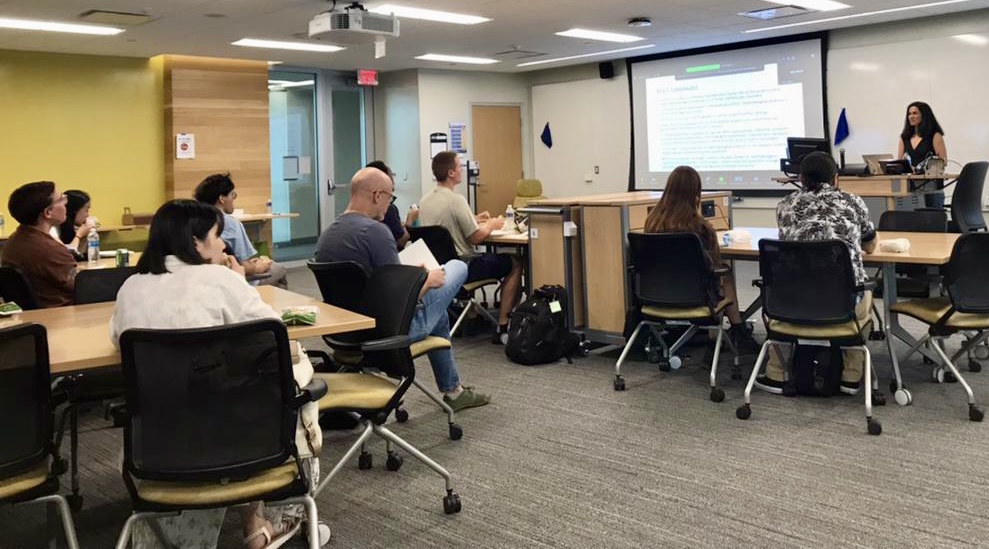
My goal is to create a class environment in which students can build both normative and empirical foundations for understanding and engaging with critical issues, such as power, justice, identity, equality, and freedom. I am committed to developing students' ability to argue coherently, persuasively, and critically, while also introducing them to cutting-edge research in political science. My teaching integrates both qualitative and quantitative methods, ensuring students gain a comprehensive understanding of political inquiry.
International Conflict Management
This course analyzes violent conflict as a strategic political process involving multiple actors, constituencies, and international interventions. It begins with the conflict trap and state fragility, emphasizing why civil wars recur and why peacebuilding efforts fail. Students examine policy tools for conflict prevention and management, including peace agreements, peacekeeping, and post-conflict programs such as DDR. A central focus is causal mechanisms: how and why particular intervention strategies succeed or backfire across contexts. The course combines theory, contemporary research, and case studies to build analytic skills for understanding conflict termination and recurrence.
Quantitative Methods in Political Science
This course introduces statistical inference and data analysis for political and policy questions, with an emphasis on building programming skills from scratch. Students learn how to summarize and visualize data, develop and interpret regression-based models, and evaluate uncertainty and evidence. The course is structured around short, frequent assignments designed to develop practical fluency in coding and statistical reasoning. Substantive applications include elections, political violence, discrimination, and policy evaluation. By the end, students can design and execute a basic data-driven research project.
Armed Group Governance
This course examines how armed groups govern and how some state-supported armed organizations operate in a grey zone adjacent to formal state authority. We study groups that provide security, practice diplomacy, or implement public policy while evading conventional legal and institutional constraints. Students engage theories of state formation, rebel governance, and political violence to explain variation in armed groups’ strategies and repertoires. The course emphasizes conflicts with internationalized dimensions and considers transitions from armed actors to state actors after rebel victory or coups. The goal is to develop a systematic framework for analyzing how armed groups exercise power and with what consequences.
Politics and Government of Latin America
This course surveys Latin America’s major political and economic challenges through a comparative lens. We examine the region’s distinct trajectories of state formation, development, and inequality, as well as democratic breakdown and transitions back to competitive politics. Topics include corruption and clientelism, human rights and political violence, transitional justice, and the war on drugs. The course also highlights citizen mobilization around race, gender, and LGBTQ rights, and situates Latin American politics in a global context, including relationships with the United States and Canada.
Political Violence, State Fragility, and State-Building
This course explores the causes and consequences of state fragility, focusing on how political violence erodes the capacity and legitimacy of state institutions. Through cases across regions, we examine what states are expected to do, what it means for them to be fragile or failing, and why fragility emerges. We analyze domestic and international responses, including third-party interventions, reconstruction efforts, and strategies for rebuilding democratic institutions. The course also engages debates on whether external actors can promote durable governance and social reconciliation after civil conflict. We conclude by evaluating state-building as a pathway to reducing political violence and sustaining peace.
Introduction to Comparative Politics
This course introduces core themes in comparative politics by examining how political institutions, development patterns, social structures, and violence vary across countries. Students learn how comparativists build and test arguments using cases, concepts, and evidence. We study the formation and functioning of states, regime types, and how power is obtained and maintained. The course also engages debates on culture, ethnicity, ideology, and political economy, and asks when broad concepts travel well across contexts. Throughout, students connect contemporary events to theoretical frameworks and comparative methods.
- Research Methods in International Studies (Fall 2023)
- State Failure and Reconstruction (Summer 2023)
- Causal Inference for the Social Sciences (Jake Bowers and Thomas Leavitt), 2023
- Causal Inference for the Social Sciences II (Sebastian Calonico and Gonzalo Vazquez-Bare), 2023
- Regression III — Advanced Methods (Dave Armstrong), 2022
- Simultaneous Equation Models (Sandy Marquart-Pyatt), 2021
- Causal Inference (Jake Bowers), 2020
- Maximum Likelihood Estimation (Robert Lupton), 2020